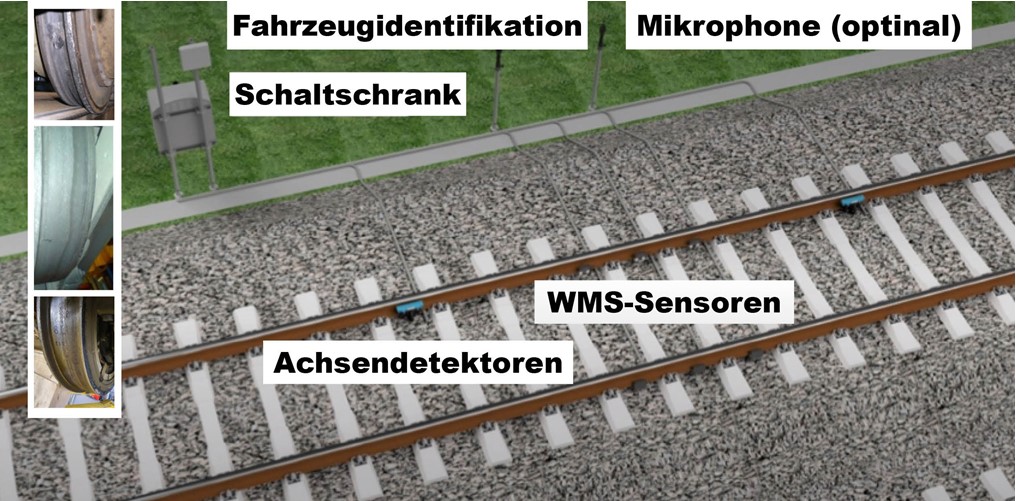
As part of a research project, Müller-BBM Rail Technologies conducted a comprehensive investigation into the occurrence and effects of wheel out-of-roundness on railway noise, vibrations, and infrastructure stress.
The measurements were conducted at the Sempach Railway Field Laboratory (Switzerland). A Wheel Monitoring System (WMS) from Müller-BBM Rail Technologies was used, which precisely records and evaluates flat spots, polygons, and acoustic wheel roughness during operation.
The results clearly show that flat spots and acoustic wheel roughness, in particular, lead to significantly increased noise emissions. Pronounced flat spots, for example, can significantly increase the pass-by noise level of freight cars while simultaneously increasing vibrations and the dynamic load on the superstructure. High acoustic wheel roughness also contributes significantly to increased emissions, while polygonal deformations primarily affect infrastructure stress.
Clear differences are evident between vehicle types: While passenger trains predominantly exhibit high wheel quality, polygonal deformations and increased roughness occur more frequently in locomotives. Freight cars exhibit the highest overall incidence of wheel out-of-roundness.
The results underscore the critical importance of good wheel condition for reducing noise and vibration emissions as well as for sustainable infrastructure. Condition monitoring systems such as the WMS enable targeted and predictive maintenance.
Would you like to learn more about the results or evaluate the use of condition monitoring systems on your network? Please feel free to contact us.